
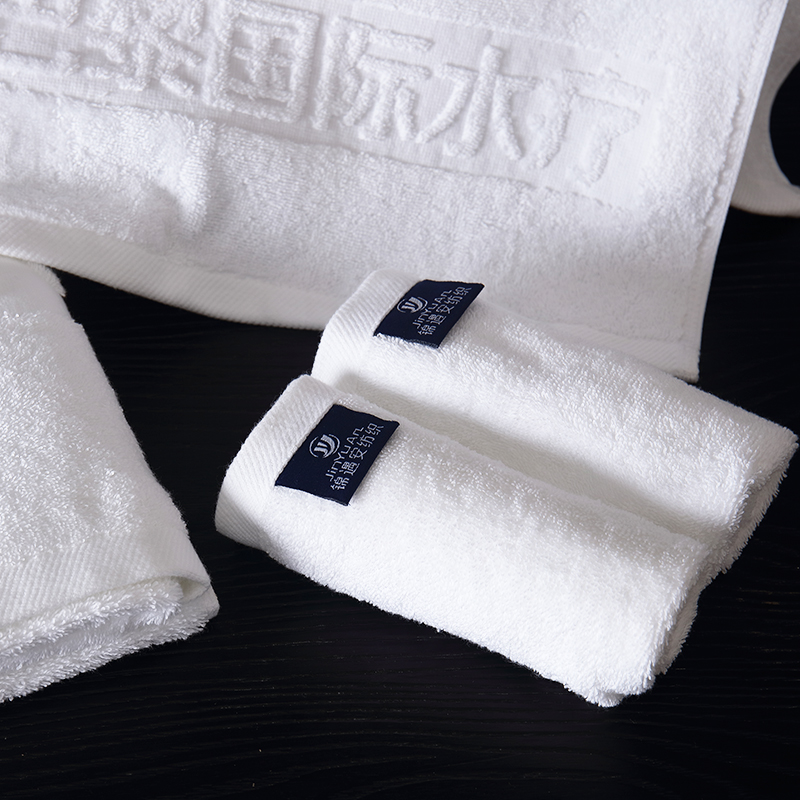
Towels are the most heavily used textile in most hotels and the one guests are quickest to judge. When comparing quotations, the number that gets the most attention is GSM. It matters, but it is a proxy for weight rather than a complete measure of quality.
These are the towel questions that come up most often during specification and tendering.
1. What does GSM mean for a towel?
GSM is grams per square metre — the mass of the fabric per unit area. For towels it is a reasonable indicator of density and substance. A 500 GSM towel will feel thinner than a 700 GSM towel of the same construction, and will generally absorb less water per unit area.
Where GSM becomes misleading is when it is treated as the whole specification. It describes how much material is in the towel, not how well that material performs.
2. What GSM ranges are typical for hotel towels?
Broadly, the market divides like this:
- Around 350–450 GSM: lighter towels, often used for gyms, pools or economy properties where fast drying and laundry volume dominate.
- Around 450–550 GSM: the mainstream range for midscale hotels — a balance of feel, absorbency and drying time.
- Around 550–700 GSM: upscale properties, where guests expect a heavier, more substantial towel.
- Above 700 GSM: luxury and spa, where plushness is the point and longer drying times are accepted.
These are conventions rather than rules. A well-constructed 500 GSM towel can outperform a poorly made 600 GSM one, which is exactly why GSM should not be the only line in the specification.
3. Why does a heavier towel not always absorb more?
Because absorbency depends on the fibre, the yarn and the finishing, not just the mass. Several factors intervene:
- Fibre type. Cotton absorbs well; some synthetic content reduces uptake significantly.
- Yarn structure. Looped pile with open, untwisted yarn absorbs faster than tightly twisted yarn of the same weight.
- Finishing agents. Softeners and some anti-pilling treatments can coat the fibre surface and reduce water uptake.
- How absorbency is measured. Sink time, water retention percentage and wicking rate are different tests. Two towels can rank differently depending on which one is used.
This is why a responsible supplier will quote absorbency as a measured result from a stated test method rather than implying it from weight.
4. How should absorbency be specified?
Ask for it as a measurable value with a test reference. Useful ways to express it:
- Sink time — the time for a towel to become fully wetted, measured under a defined procedure.
- Water retention — the mass of water held per unit mass of dry fabric.
- Wicking rate — how quickly water travels through the fabric, relevant for how a towel feels in use.
Whichever is used, it should be paired with an acceptance threshold so that delivery can be checked against the agreed figure. An absorbency claim without a test method and a threshold cannot be enforced.
5. How do I balance absorbency against drying time?
This is the central trade-off in towel specification, and it is a laundry question more than a comfort question. Heavier, more absorbent towels hold more water after use, so they take longer to dry and consume more energy per cycle.
A practical approach is to set the specification from the laundry outward:
- Establish how many towel changes per room per day the property actually produces.
- Establish the drying capacity available in the laundry window.
- Calculate the maximum weight of towel that capacity can absorb per cycle.
- Set GSM and size so the resulting rotation fits inside that limit.
Done this way, the specification is derived from an operational constraint rather than from a preference. It also makes the cost conversation concrete, because laundry consumption becomes a visible line rather than a hidden one.
6. What else belongs in a towel specification?
- Dimensions — bath, hand, face and bath mat sizes, with tolerances.
- Weight — GSM plus the piece weight for each size, which is what the laundry actually pays for.
- Fibre content and the acceptable tolerance on blend ratios.
- Shrinkage after a stated number of washes, with a maximum percentage.
- Colour fastness to washing, rubbing and light, matched to your laundry chemistry.
- Pile retention — how much lint the towel sheds, which affects both appearance and drain maintenance.
- Selvedge and hem construction, since edges are where towels fail first.
- Branding — jacquard, embroidery or woven label, and its position.
Shrinkage and pile retention are the two items most often left out and most often responsible for complaints after a few months of service. Both are measurable and both should carry a numeric limit.
7. Does a higher GSM towel last longer?
Not necessarily. Longevity depends on how the fibre and yarn withstand repeated washing, drying and the mechanical action of the laundry. A dense towel made from short-staple yarn can pill and shed, while a lighter towel from good long-staple cotton holds up well.
The way to know is to ask for wash-cycle test data — for example appearance and dimensional change after a stated number of commercial cycles — rather than inferring durability from weight.
The short answer
GSM tells you how heavy a towel is, which is a useful but incomplete signal. Absorbency, drying behaviour and service life depend on fibre, yarn, finishing and construction, and each should be specified as a measured value with a threshold.
Start from your laundry: work out how much towel weight you can dry in a shift, then choose GSM and size to fit. If you share your property type, expected occupancy and laundry capacity, a hotel textile supplier can propose a towel specification that meets the guest expectation without overloading the laundry.