
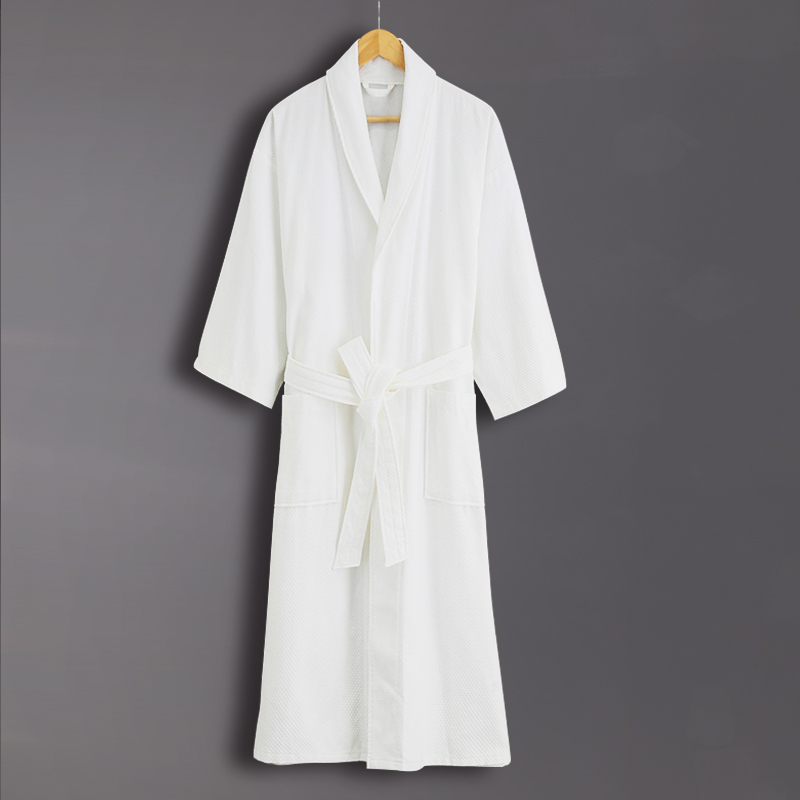
Bathrobe fabric is usually the first decision in a hotel textile programme and one of the most frequently revisited. The three constructions available to most buyers — waffle, terry and plain cotton — differ not just in feel but in weight, drying behaviour and how much they cost you to launder over their life.
These are the fabric questions that come up most often when buyers are comparing options.
1. What is the actual difference between waffle and terry?
Terry is a looped construction. Yarn is pulled into loops that stand up from the base fabric, which is what gives terry its thick, plush hand and its high water uptake. Because the loops present a large surface area and trap air, terry feels warm and absorbs quickly.
Waffle is a woven structure with a raised grid pattern. It uses less yarn per square metre, so it is lighter and dries faster, and the grid creates small air pockets that give it a soft, textured hand. It absorbs less water than terry of the same weight.
The practical consequence: terry is the choice when absorbency and a sense of luxury matter most, and waffle is the choice when drying speed and laundry throughput matter most.
2. Which fabric dries faster, and why does that matter commercially?
Waffle dries faster, and in a hotel this is a commercial fact rather than a comfort preference. Drying time determines how many robes you need in rotation and how much energy the laundry consumes per robe.
A robe that dries in half the time effectively doubles the throughput of a fixed drying capacity. For properties running tight laundry windows — or outsourced laundries charging by weight and cycle — a lighter, faster-drying fabric reduces both the capital tied up in inventory and the recurring laundry cost.
This is why the right question is rarely "which fabric feels nicer" but "which fabric fits our laundry reality".
3. What does GSM tell me, and what does it not tell me?
GSM — grams per square metre — tells you the weight of the fabric. It is a useful indicator of density and, to a degree, of how substantial the robe will feel. It does not tell you:
- Absorbency. Two fabrics at the same GSM can differ substantially in water uptake depending on fibre type and construction.
- Durability. Weight is not the same as wash resistance. Yarn quality, dyeing and finishing decide how the robe survives cycles.
- Comfort. A heavier robe is not automatically more comfortable for a given climate or guest segment.
Use GSM as one input alongside construction, fibre and finishing — not as a standalone quality score.
4. Is cotton always better than a cotton blend?
Not automatically. Pure cotton offers the best combination of absorbency, breathability and hand feel, and it is what most hotel guests expect. Blends can improve dimensional stability, reduce shrinkage and lower cost.
The trade-off is that a blend may feel less natural and absorb less. For premium guest tiers, pure or high-cotton-content constructions are usually worth the cost. For high-turnover properties where the robe is laundered aggressively, a blend that holds its shape can last longer and present better after many cycles.
The honest answer depends on whether your priority is the first impression or the hundredth wash. Both are legitimate — they simply point to different fabrics.
5. Which fabric suits which guest segment?
- Economy and midscale: lighter constructions, often waffle or a lighter terry, where durability and laundry efficiency dominate.
- Upscale: mid-weight terry or a well-finished cotton robe, where the guest expects a substantial feel.
- Luxury and resort: heavier terry or premium cotton, sometimes layered — a light waffle liner with a heavier outer robe.
- Spa and wellness: waffle is common because it dries quickly between treatments and packs down well.
The segment does not dictate the answer mechanically, but it tells you which trade-off the guest will notice.
6. What should I specify when ordering bathrobes?
- Fabric construction: waffle, terry or plain weave
- Fibre content and the acceptable blend tolerance
- Weight, expressed as GSM and, ideally, as fabric weight for a stated size
- Size range and the sizing standard you are buying against
- Shrinkage tolerance after a stated number of wash cycles
- Colour fastness requirement for the laundry chemistry you use
- Collar, cuff and belt detail, and whether the belt is attached or separate
- Branding: embroidery, woven label or jacquard, with placement
- Laundry environment: in-house or outsourced, and typical cycle temperature
Two items on that list are frequently omitted and frequently cause problems: shrinkage tolerance as a measured value, and the laundry chemistry the robe must survive. A supplier who knows both can recommend a fabric that still looks right after a year of service rather than one that photographs well on delivery.
7. Can I mix fabrics across a property?
Yes, and it is often the right answer. Many hotels use a heavier robe in suites and a lighter, faster-drying robe in standard rooms, or a waffle robe for the spa and a terry robe for guest bathrooms. Mixing lets you match fabric to the experience in each space rather than applying one specification everywhere.
The requirement is that the colours and branding stay consistent, or the property starts to look inconsistent to a returning guest. Design the range deliberately rather than drifting into it.
The short answer
Waffle dries faster and suits high-turnover and spa environments. Terry absorbs more and delivers the plush feel guests associate with upscale stays. Plain cotton sits between them and is the safe default for premium tiers.
Choose by laundry reality first, guest expectation second, and unit price last — because the fabric that costs least per robe is often not the one that costs least per year. If you describe your property type, guest tier and laundry setup, a hotel textile supplier can narrow the choice to one or two constructions immediately.