
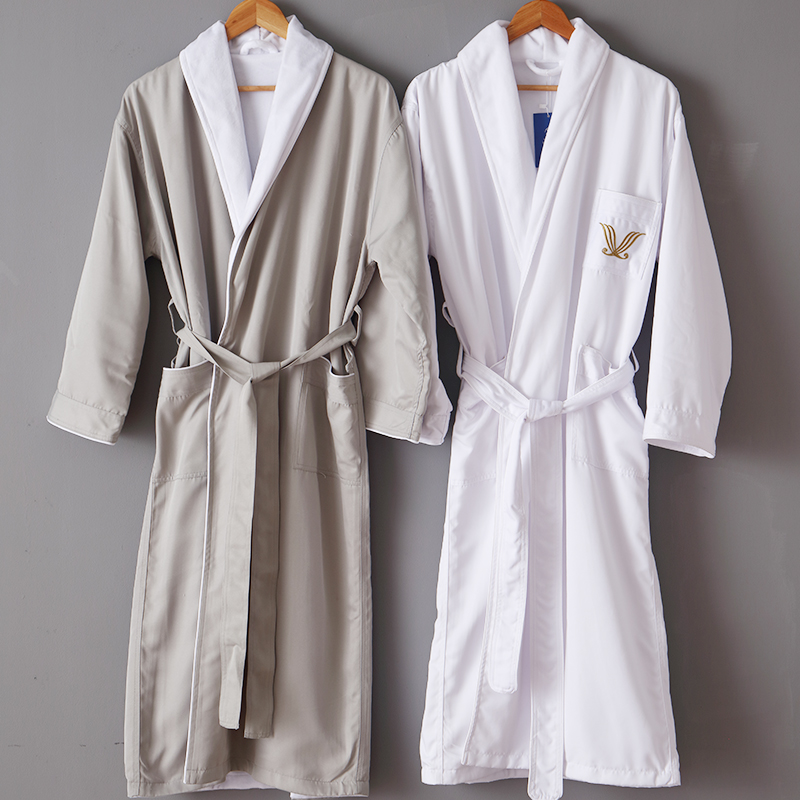
Once the fabric is chosen, the remaining robe decisions are about fit and how the garment holds up. These are the questions that generate the most back-and-forth between hotels and suppliers, largely because they are usually left to assumption.
Here are the ones that come up most often, with the practical answer for each.
1. What sizes should a hotel stock?
Guests are not one size, and a robe that fits badly is a complaint even if the fabric is excellent. Most properties settle on a small range rather than a single size:
- Two sizes — typically a regular and a large — covering the majority of adult guests. This is the most common and most cost-effective approach.
- Three sizes — small, regular and large — for properties with a wide guest mix or a significant proportion of international travellers.
- One size with a generous cut — a deliberate wrapped fit with a wide overlap, common in resorts and spas where robes are often worn loosely.
A single-size approach works only if the cut is designed for it. Simply taking a mid-size robe and calling it one-size creates a garment that fits few guests well.
2. How should sizes be defined?
By measurements, not by labels. "Large" means different things in different markets, so a specification should state the actual garment dimensions:
- Chest width, measured flat across the robe
- Length from the high point of the shoulder, or from the collar seam, to the hem
- Sleeve length from the shoulder seam
- Shoulder width
- Belt length, and whether it is attached or threaded
Ask the supplier to provide a size chart with these dimensions plus a tolerance for each. That converts a sizing discussion from an opinion into a comparison, and it makes reorders predictable across years and production runs.
3. How much shrinkage should I expect?
Cotton and cotton-rich robes will shrink the first time they are laundered, and the amount depends on the fabric, the finishing and the laundering conditions. Typical first-wash shrinkage in the length direction is a few percent, with slightly less across the width.
Two things make this manageable rather than problematic:
- Specify a maximum shrinkage percentage after a stated number of washes, not just "pre-shrunk".
- Cut to allow for it. A supplier who knows the expected shrinkage will add the right allowance at cutting so the robe lands at the specified size after washing, which is the size the guest actually experiences.
The danger is a robe that measures correctly on delivery and is undersized after three washes. That is a specification failure, not a laundry failure, and it should be prevented at cutting rather than corrected later.
4. What laundry conditions affect robe life most?
In order of impact:
- Drying temperature. The single most damaging variable for cotton robes and for any attached belt or trim. High heat accelerates fibre degradation, shrinkage and colour loss.
- Detergent and bleach chemistry. Aggressive bleaching shortens fibre life and fades colour. Robes should be laundered with chemistry matched to the fabric, not with whatever the towel load uses.
- Mechanical action. Over-loaded machines flex and abrade the fabric, and stress seams and belt attachment points.
- Cycle count. Cumulative cycles are the underlying cause of most eventual wear, which is why the laundering regime rather than the fabric alone determines service life.
Robe life is therefore a shared outcome between the textile and the laundry. A supplier can make a robe that tolerates a demanding regime, but it must know what that regime is.
5. How should robes be cared for between uses?
Between guest stays, robe handling matters more than most properties assume:
- Hang rather than fold wherever possible, so the fabric recovers its shape and dries fully.
- Inspect at the point of making up the room for pilling, frayed hems, stretched cuffs and belt wear, and remove rather than reissue.
- Rotate stock so no single robe takes the full cycle load while others sit unused.
- Treat the belt as a wear item. Belts and their attachment points fail before the body of the robe does, and a missing belt takes the whole robe out of service.
These habits cost nothing and extend useful life noticeably. The alternative is a property that replaces robes on appearance rather than on actual wear.
6. How do I handle branding without hurting durability?
Branding is usually embroidery on the chest or a woven label, and the choice affects wash performance:
- Embroidery is durable and visible, but dense stitching can stiffen the fabric locally and may pucker after repeated washing. Backing material quality matters.
- Woven labels are stitched in and wear well, but they are less prominent and require a seam position that suits the design.
- Jacquard woven logos are the most durable and the most premium-looking, since the motif is part of the fabric rather than applied to it. They come with higher minimum quantities and longer lead times.
Whatever the method, the branding should be specified in the same document as the fabric and shrinkage requirements, so that the finished garment is validated as a whole rather than as separate components.
7. What belongs in a robe specification?
- Fabric construction, fibre content and GSM
- Size range with a full dimension chart and tolerances
- Shrinkage limit after a stated number of washes
- Colour fastness for your laundry chemistry
- Collar, cuff, pocket and belt detail, and belt attachment method
- Branding method, size and placement
- Packaging and label requirements
- Laundry conditions the garment must tolerate: temperature, chemistry, cycle count
Two lines carry the most weight in practice: the dimension chart with tolerances, and the shrinkage limit after a stated wash count. Together they define a garment that will still fit the guest six months into service, which is the only moment that matters commercially.
The short answer
Size robes by measured garment dimensions rather than labels, stock two or three sizes for a mixed guest population, and specify shrinkage as a maximum percentage after a stated number of washes — then cut with the allowance built in.
After that, robe longevity is mostly a laundry question. Control drying temperature, match the chemistry to the fabric, rotate stock and treat belts as consumables. A supplier who understands all of this will help you set the specification so the robe performs in service, not just on the delivery inspection.