Hotel Linen Specification: Writing a Wash-Durability Requirement That Suppliers Can Quote Against
Most hotel linen complaints do not begin with a supplier's manufacturing quality. They begin with a purchase specification that described the fabric's appearance but said nothing about how many industrial wash cycles it had to survive. A bed sheet that looks correct on delivery and loses its hand feel after sixty commercial launderings was not mis-supplied — it was specified in a way that left durability undefined, so nothing in the agreement could be enforced.
Hotels operate linen under conditions home textiles never meet: high-temperature washing with alkaline chemistry, repeated chlorine or oxygen bleaching, mechanical extraction, and tunnel finishing. The specification has to describe performance across that entire cycle, not just the product's state in the sample bag. This article sets out the parameters that determine whether a linen specification is quotable and enforceable.
Why Appearance-Based Specifications Fail
Three failure patterns account for most hotel linen disputes:
- The specification described a look, not a performance. Terms such as "premium cotton" or "soft touch" carry no measurable threshold, so a supplier cannot be held to a value and the buyer cannot compare two quotations meaningfully.
- Durability was assumed rather than stated. Where no wash-cycle target appears in the specification, the supplier has no obligation to select yarn, weave or finish for repeated commercial laundering. Durability becomes a matter of luck rather than a design input.
- Size was quoted before shrinkage behaviour was fixed. If the finished dimensions are stated without the shrinkage allowance and the wash conditions they apply to, the fabric can pass incoming inspection and still fall out of tolerance after the first few production washes.
The remedy is not a longer specification. It is making each requirement measurable, so that both sides are answering the same question.
The Parameters That Belong in a Hotel Linen Specification
| Parameter | Why it must be stated | How to express it |
|---|---|---|
| Fibre composition | Determines absorbency, hand feel and how the fabric responds to bleach and heat | Percentage by fibre, with the tolerance permitted |
| Yarn count and construction | Two fabrics at the same GSM can differ substantially in durability depending on yarn and weave | Yarn count per system plus weave type |
| Weight (GSM) | Primary proxy for perceived quality and expected service life | Grams per square metre with an acceptance range |
| Finished dimensions | Determines fit against mattress and duvet sizes in use | Length and width after wash, with tolerance |
| Shrinkage | Sets the difference between cut size and finished size | Percentage maximum, with the wash method it applies to |
| Colour fastness | Bleach and heat are what cause fading and cross-staining in a shared wash load | Fastness grades for the specific exposures the laundry uses |
| Wash durability | The parameter that governs total cost of ownership | Number of industrial wash cycles to a defined pass criterion |
| Inspection basis | Without an agreed method and sampling plan, results are not comparable between lots | The test standard, sampling level and acceptance criteria |
A specification containing all eight lines can be quoted against directly. One missing line — most often wash durability — is enough to make the rest unenforceable, because the supplier retains discretion over exactly the property the hotel cares most about.
Wash Durability: The Parameter That Sets Total Cost of Ownership
Hotel linen is not bought once. It is bought repeatedly, at a frequency set by how many wash cycles each piece survives. That makes wash durability the parameter with the largest effect on lifetime cost, and the one most often left vague.
Expressing it as a number requires two further decisions, because a cycle count means nothing on its own:
- Define the wash process. A cycle at low temperature with mild chemistry is not equivalent to one at high temperature with alkaline detergent and bleach. The cycle count must reference the process the hotel's laundry actually runs, or the figure describes a different product.
- Define the pass criterion. "Survives 300 washes" needs a measurable endpoint — a maximum tensile strength loss, a maximum colour change grade, a minimum remaining GSM, or a defined visual standard. Without it, two laboratories can test the same fabric and report different results.
Once both are fixed, the number becomes a genuine procurement lever. A supplier warranting a higher cycle count is making a specific claim about yarn selection, weave density and finishing, and that claim can be verified on a sample lot before a bulk commitment. Hotels that specify durability this way generally find that the initial unit price and the lifetime cost rank the quotations differently, and that the ranking by lifetime cost is the one that holds up over a multi-year replacement cycle.
Matching the Specification to the Linen Category
Different linen items meet different loads, so a single specification applied across a whole property will be either over-specified for some items or under-specified for others:
- Bed linen (sheets, duvet covers, pillowcases). Main exposure is repeated high-temperature washing and mechanical handling. Dimensional stability and seam integrity dominate; a sheet that shrinks out of tolerance is unusable even if the fabric itself is intact.
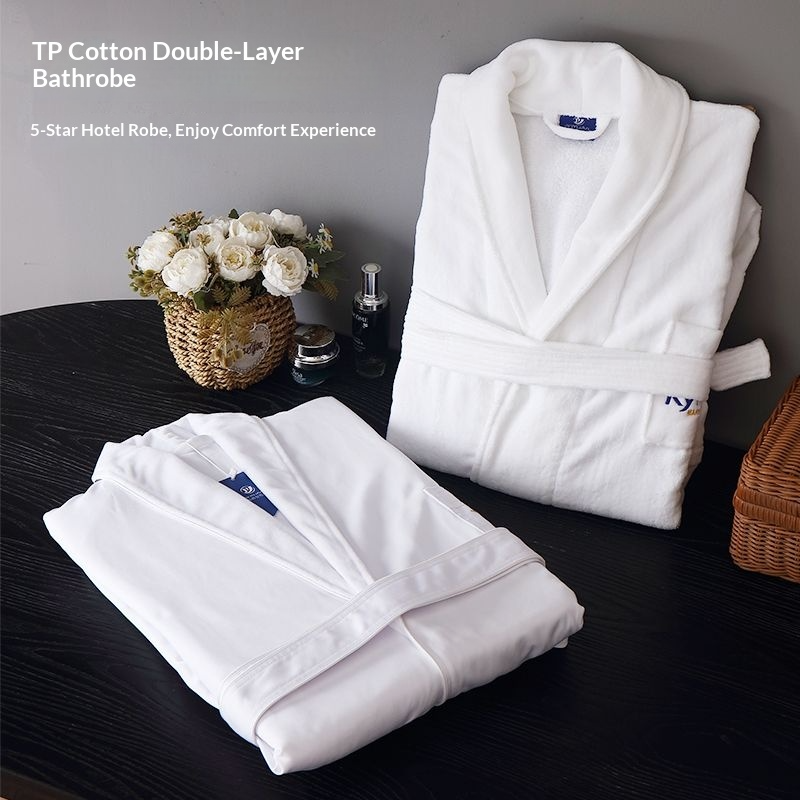
- Towels and bath mats. Main exposure is absorbency loss and pile degradation. The relevant durability questions are how absorbency holds after repeated washing and whether the pile remains stable rather than matting or shedding.
- Bathrobes. Main exposure combines washing with abrasion from use, plus belt and seam stress. Construction details — belt attachment, seam type, edge finishing — determine service life as much as the fabric does.
- Pillows and protectors. Main exposure includes fill settlement and cover durability. Support retention over time matters more than initial loft.
Where a property sources across all four categories, the specification should be organised by category with shared requirements stated once, rather than written as a single document. This keeps the enquiry short enough to be answered while ensuring no category is left without a durability figure.
From Specification to Enforceable Order
A linen specification only becomes useful when it travels intact into the order and the inspection regime. Three habits make that happen:
- Attach the specification to the sample approval. When a sample is approved, record which specification revision it was approved against. Otherwise the approved sample and the written requirement can drift apart between trial and bulk production.
- State the retest basis. Agree in advance which parameters will be retested on bulk delivery, on what sampling, and what happens if a result falls outside tolerance. Durability parameters are usually verified by accelerated washing of a sample rather than by destructive testing of delivered goods.
- Keep the wash conditions on record. Since durability figures are only meaningful relative to a wash process, note the process assumed. If the hotel later changes laundry chemistry or temperature, the durability expectation has to be revisited rather than assumed to still hold.
Conclusion
Hotel linen specification is not a matter of adding more descriptive language. It is a matter of making each requirement measurable and ensuring the parameters that drive lifetime cost are stated explicitly rather than left to supplier discretion. Fibre, yarn and weave establish what the fabric is; dimensions, shrinkage and colour fastness establish how it behaves; wash durability, tied to a defined process and pass criterion, establishes how long it lasts. When all three groups are fixed in the enquiry, quotations become comparable and the delivered goods can be held to the standard the hotel actually needs.
Jiangsu Jinyuan Textile manufactures hotel linen and bedding within an integrated operation covering research, design, weaving and finishing, and operates to the product concept of "organic, comfortable and healthy sleep" with ISO 9001 certification. For projects where specific wash-durability or dimensional requirements apply, those figures should be stated in the enquiry so they can be confirmed against the intended laundry process.