
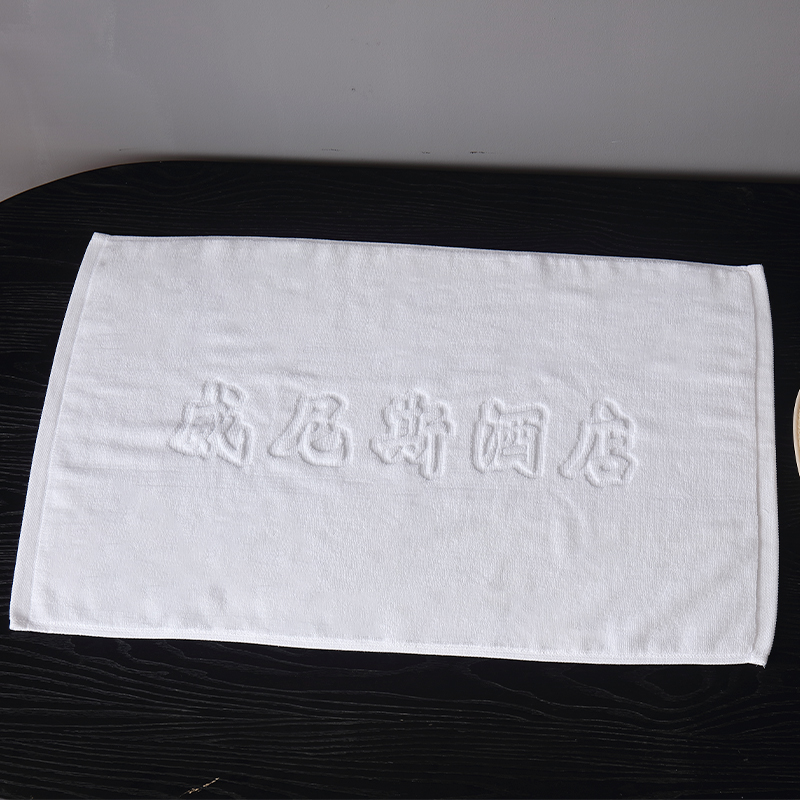
Bath mats sit at the intersection of safety, housekeeping and guest perception. They are cheap per unit and easy to overlook, yet a mat that slides on a wet floor is a genuine incident risk, and a mat that stays damp creates odour, mildew and repeat complaints.
These are the bath mat questions that come up most often during specification.
1. How should anti-slip performance be specified?
Anti-slip should be a stated and testable property, not a claim. Useful ways to express it:
- Whether a backing is present, and what it is made of. Latex, rubber and sprayed PVC are common. Each behaves differently when wet and under repeated laundering.
- Measured slip resistance using a recognised test method, with a minimum coefficient of friction threshold.
- Performance wet and dry. A mat that grips well when dry but slides when wet has not solved the actual problem, since bathroom floors are wet by definition.
Ask for the test method and the result, not just the word "anti-slip". Unsupported anti-slip claims are one of the most common gaps in bath mat specifications, and the one with the clearest safety consequences.
2. Does anti-slip performance survive laundering?
It degrades, and the rate depends on the backing and the laundry process. Factors that accelerate wear:
- High drying temperatures, which degrade latex and rubber backings and cause them to crack or peel.
- Excessive detergent or bleach, which attacks the backing material.
- Mechanical action in over-loaded machines, which flexes and abrades the backing.
This makes bath mat specification a shared responsibility between the textile supplier and the laundry. If the property dries at high temperature, a backing that tolerates it should be selected — or the drying practice should be reconsidered. Ask the supplier for a cycle-life figure for the backing under a stated drying temperature, then check that against your actual practice.
3. What determines how well a mat absorbs water?
The same factors that govern towels: fibre type, pile structure and finishing. Cotton with an open looped pile absorbs quickly and holds well. Mats with a high synthetic content or heavy softening finish may repel water initially, which produces the "the mat did not work" complaint even though the fabric is intact.
Absorbency for a mat is best expressed as the total water the mat will take up, since a mat is expected to handle a larger volume of water than a hand towel. Ask for water retention as a measured percentage or per-unit figure.
4. Why do mats stay damp, and how do I prevent it?
Drying time is the usual culprit, and mats are the worst case in any hotel linen set because they lie flat, often on a tiled floor, with limited airflow. Three practical measures:
- Choose a lighter, faster-drying construction if the bathroom has no airflow and the mat will sit on the floor all day.
- Ensure housekeeping hangs or drape-dries mats between uses rather than leaving them flat on the floor.
- Rotate mats so each one gets a full drying interval, rather than returning the same mat to service immediately.
Mats that stay damp develop odour and mildew, and no specification change will fix that if the drying routine is wrong. This is one case where housekeeping practice matters as much as the product.
5. What sizes should a property stock?
Most hotels need more than one size, because bathrooms differ:
- Standard bath mat for the floor area in front of the shower or bath.
- Larger mat or runner for double-vanity or larger bathrooms.
- Small mats for shower cubicle entries or secondary wet areas.
A common mistake is to standardise on one large size to simplify housekeeping, which then bunches or overhangs in small bathrooms and drives up laundry weight unnecessarily. Measure the actual bathrooms in the property and stock the two or three sizes that fit them.
6. What belongs in a bath mat specification?
- Dimensions for each size required, with tolerances
- Fibre content and pile construction
- Weight: GSM and piece weight per size
- Backing type, material and method of application
- Slip resistance: test method and minimum threshold, wet and dry
- Backing durability under a stated drying temperature and cycle count
- Water retention as a measured figure
- Colour fastness to washing and rubbing
- Shrinkage after a stated number of washes
- Branding, if the property requires a woven or embroidered logo
The two items that most distinguish a good specification from a weak one are the slip resistance threshold with its test method, and the backing durability under your actual drying temperature. Both are easy to include and both prevent the most common failure modes.
7. Are mats the same as towels from a procurement standpoint?
Not quite. A mat is subjected to heavier point loads and rougher handling than a towel, and it is the item most likely to be stood on with wet feet or used to mop up a spill. That means the backing and the edge construction take more stress, and the mat will generally need replacing more often than a towel of comparable weight.
It is worth tracking mats as a separate line in the replacement budget rather than folding them into the general towel figure, so that their failure rate is visible.
The short answer
For a bath mat, specify two things with numbers: slip resistance measured wet with a stated test method, and backing durability at your actual drying temperature. Get those right, choose a construction that dries in your bathroom's airflow, and support it with a housekeeping routine that lets each mat dry between uses.
Everything else — size, colour, branding — follows from those decisions. If you describe your bathroom types and laundry practice, a hotel textile supplier can recommend a mat construction and backing that holds its grip for the life of the mat rather than for the first month.